How NRIs can Slash Capital Gains Tax

Selling property or assets in India as a Non-Resident Indian (NRI) often feels like a high-stakes game of financial chess. You’ve made a great investment, the market has peaked, and you’re ready to repatriate your gains. But then, the "Taxman’s Giant Straw" appears in the form of Tax Deducted at Source (TDS).
Without the right preparation, a buyer might deduct up to 30% from your gross sale proceeds, not just your profit. For an NRI selling a property worth ₹2 Crores, that’s nearly ₹30 Lakhs of your liquidity potentially locked in the Indian tax system for over a year.
This is where Section 197 of the Income Tax Act—the Application for Lower or Nil Deduction Certificate—becomes your most valuable strategy.
The Core Conflict: TDS vs. Actual Tax Liability
The fundamental issue for NRIs is the disparity between how the law expects you to be taxed and how the buyer is required to deduct tax.
The Buyer’s Burden: Under Section 195, a buyer is legally responsible for deducting TDS on the full payment made to an NRI. To play it safe and avoid penalties, buyers often deduct tax on the total sale consideration.
The NRI’s Reality: You are only liable to pay tax on the capital gains (the profit), not the total price. Furthermore, if you plan to reinvest those gains under Section 54 or 54EC, your actual tax liability might be zero.
The Solution: A Lower Deduction Certificate (LDC) issued under Section 197. This document is a formal instruction from the Income Tax Department to the buyer, authorizing them to deduct tax at a specific, much lower rate (or even zero).
Understanding the 2026 Tax Landscape for NRIs
As of 2026, the tax rates have seen significant shifts. Following the updates from previous budgets, the rates for NRIs generally stand as follows:
1. Long-Term Capital Gains (LTCG)
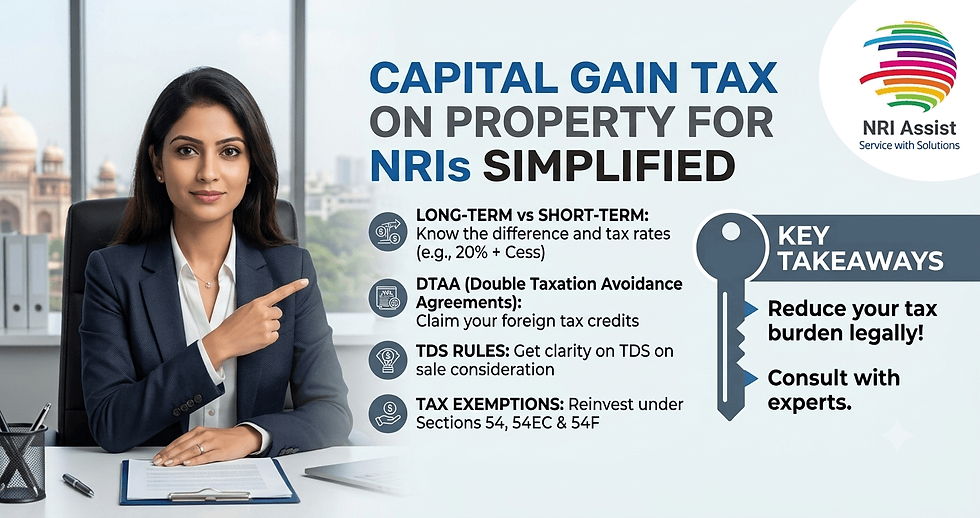
If you hold an immovable property for more than 24 months, it is classified as a long-term asset.
Tax Rate: 12.5% (Note: Since 2024, the indexation benefit has been largely removed for new transactions, but the base rate was lowered from 20% to 12.5%).
TDS without Certificate: Often deducted at an effective rate of ~20% to 25% (including surcharge and cess) on the total sale price.
2. Short-Term Capital Gains (STCG)
If held for 24 months or less.
Tax Rate: As per your applicable income tax slab rates.
TDS without Certificate: Usually deducted at the maximum marginal rate of 30% (plus surcharge and cess) on the total price.
Why You Should Apply for an LDC
Let’s look at a practical example of why this matters. Suppose you are selling a property for ₹2,00,00,000 (2 Crores) that you bought for ₹1,40,00,000.
Scenario A: No Section 197 Certificate
The buyer, fearing a notice from the tax department, deducts TDS at a conservative effective rate of 14.95% on the gross value.
TDS = 2,00,00,000 \times 14.95\% = ₹29,90,000
Scenario B: With Section 197 Certificate
Your actual capital gain is $₹2,00,00,000 - ₹1,40,00,000 = ₹60,00,000
At a 12.5% tax rate (ignoring surcharge/cess for simplicity), your actual tax is:
Tax = 60,00,000 \times 12.5\% = ₹7,50,000$$
By obtaining an LDC, you prevent ₹22,40,000 from being unnecessarily blocked. You can use this money immediately for other investments rather than waiting 12–18 months for a tax refund.
The Application Blueprint: Form 13
The application for a lower or nil deduction is made using Form 13 on the TRACES (TDS Reconciliation Analysis and Correction Enabling System) portal.
Essential Document Checklist
To ensure your application isn't "ping-ponged" back with queries from the Assessing Officer (AO), keep these ready:
PAN of Seller & Buyer: Ensure your PAN is "operative" and linked with Aadhaar (if applicable).
TAN of the Buyer: The buyer must have a Tax Deduction Account Number. If they don't, they need to apply for one (Form 49B) before you can finish your application.
Sale Agreement: A signed Agreement to Sell (ATS) or a Memorandum of Understanding (MoU).
Original Purchase Deed: To prove the cost of acquisition and the date of purchase.
Cost of Improvement: Invoices/proofs for any major renovations that can be added to the cost base.
Income Tax Returns (ITR): Usually, the last 3 years of Indian ITR acknowledgments.
Proof of NRI Status: Passport copies (stamps), OCI card, or a Tax Residency Certificate (TRC) from your current country.
Step-by-Step Procedure to Apply
Register on TRACES: Log in as a 'Taxpayer' using your PAN.
Fill Form 13: Navigate to the ‘Statements/Forms’ tab and select ‘Request for Form 13’.
Upload Calculations: You must provide a detailed "Computation of Capital Gains." This is where you justify why the TDS should be lower.
Select the Jurisdictional AO: The application is routed to the Assessing Officer who handles your PAN or the location of the property.
Respond to Queries: In 2026, the process is mostly digital, but an AO might still ask for clarifications via the portal.
Download the Certificate: Once approved, the certificate is generated digitally. You then provide this to the buyer.
Strategic Exemptions: Sections 54 and 54EC
If you intend to reinvest your gains to reach a "Nil" tax liability, the Section 197 application is your best friend.
Section 54: If you buy another residential property in India.
Section 54EC: If you invest up to ₹50 Lakhs in specified bonds (like REC or NHAI).
If you provide proof of these investments (or a declaration of intent to invest), the AO can issue a Nil Deduction Certificate, allowing the buyer to pay you the full amount without any tax deduction.
Timeline and Validity
When to Apply: You should apply as soon as the Agreement to Sell is signed. Do not wait for the final closing date.
Processing Time: It typically takes 30 to 45 days. If your documentation is airtight, it can be faster.
Validity: The certificate is valid only for the Financial Year (FY) in which it is issued and only for the specific transaction/buyer mentioned. If your deal spills over from March 31st to April 1st, you will likely need a fresh certificate.
Common Pitfalls to Avoid
Inconsistent Data: Ensure the sale value on Form 13 matches exactly with your Agreement to Sell.
Buyer’s TAN: Many individual buyers do not have a TAN. They must apply for it; otherwise, you cannot complete the TRACES filing.
Ignore the "Refund" Trap: Some NRIs think, "I'll just claim a refund later." While true, the opportunity cost of having millions of rupees stuck at 0% interest with the government is a heavy price to pay.
Source Income Tax Website : https://www.incometaxmumbai.gov.in/application-us-197/
Conclusion
The Section 197 Certificate is not just a form; it is a liquidity tool. In the 2026 tax environment, where transparency is high and digital tracking is absolute, taking the proactive route of filing Form 13 ensures you stay compliant while keeping your hard-earned money in your own pocket.
NRI Assist Services plays a major role here managing all these complicated process for saving your taxes.
Contact NRI Assist Services today and get a free consultation! ☎️
WhatsApp: https://wa.me/message/2KGAATYMDLUPN1
Visit us at https://nriassist.in.


Comments