Capital Gains Tax on Property for NRIs: A Simplified Guide
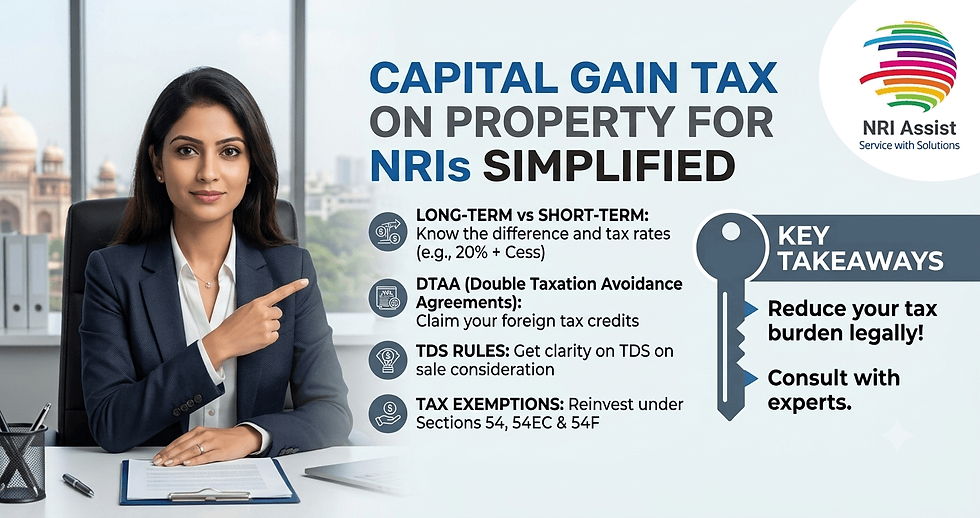
Selling real estate in India as a Non-Resident Indian (NRI) can offer high returns, but navigating Indian tax laws often feels overwhelming. From high upfront TDS rates to capital gains tax calculations, understanding your tax obligations ensures a smooth transaction without getting your money stuck in tax disputes.
Here is a plain-language breakdown of how capital gains tax works for NRI property sales in India, including key tax rates, TDS rules, and legal exemptions.
1. Classifying the Gain: Long-Term vs. Short-Term
Taxation depends on your holding period (how long you owned the property):
Long-Term Capital Gain (LTCG): Property held for more than 24 months (2 years).
Short-Term Capital Gain (STCG): Property held for 24 months or less.
Inherited Property Note: If you inherited the property or received it as a gift, the holding period includes the time the previous owner held it. The original acquisition cost paid by the previous owner is used to calculate your taxable gain.
2. Applicable Tax Rates
Holding Period | Asset Category | Tax Rate | Indexation Benefit |
> 24 Months | Long-Term Capital Gain (LTCG) | 12.5% (+ surcharge & 4% cess) | No (Flat rate applies) |
≤ 24 Months | Short-Term Capital Gain (STCG) | Applicable Slab Rate (up to ~30% + surcharge/cess) | No |
3. The TDS Trap: What Every NRI Seller Must Know
The biggest point of confusion for NRI sellers is Tax Deducted at Source (TDS).
When a resident Indian buys a property, TDS (1%) applies only to transactions above ₹50 lakh. However, when buying from an NRI, the buyer is legally required to deduct TDS under Section 195 on the entire sale consideration (no minimum threshold).
Standard TDS Rates Deducted by Buyer
LTCG Sales: ~12.5% to 15%+ (including applicable surcharge and 4% health & education cess).
STCG Sales: ~30% to 34%+ (depending on surcharge slabs and cess).
Because the buyer deducts tax on the total sale value rather than your actual profit, a huge portion of your capital stays locked with the tax department.
How to Avoid Excess TDS Deduction
You do not have to let the buyer deduct tax on the full sale amount:
Apply for a Lower / Nil TDS Certificate (Form 13): Apply via the TRACES portal before completing the sale. The Assessing Officer calculates your actual profit (or exemptions) and issues a certificate directing the buyer to deduct tax only on the net capital gain or at a reduced rate.
Claim a Refund via Income Tax Return (ITR): If excess TDS was deducted, you can claim a refund by filing an Indian ITR at the end of the financial year.
4. Legally Save on Tax: Capital Gains Exemptions
NRIs can reinvest their long-term capital gains to reduce or eliminate their Indian tax liability:
Section 54: Reinvest the capital gain into purchasing or constructing up to two residential properties in India (subject to a ₹2 crore gain cap for the two-property option) within specified time limits.
Section 54EC: Invest the capital gains into specified capital gains bonds (such as NHAI or REC) within 6 months of the sale, up to a maximum limit of ₹50 lakh. The lock-in period for these bonds is 5 years.
Section 54F: Reinvest the net sale proceeds from selling a non-residential asset (e.g., commercial land/property) into a single residential house property in India.
5. Repatriating Proceeds Abroad
Once the transaction is complete, you can repatriate up to USD 1 million per financial year out of your NRO account. To complete the bank transfer, you must submit Form 15CA and a Chartered Accountant certificate (Form 15CB) confirming that all taxes in India have been paid.
Under the Double Taxation Avoidance Agreement (DTAA) between India and your resident country (e.g., USA, UK, UAE, Canada), you can generally claim a foreign tax credit in your home country for taxes paid in India to avoid paying double tax.
For Any help in above matter please write to us at hello@bluehelmet.in or WhatsApp us at : https://wa.me/message/2KGAATYMDLUPN1 +91 9810915147
Visit our Home Page Click Here


Comments