What NRIs Expect From Budget 2026?

As the sun rises on February 1, 2026, over 32 million Non-Resident Indians (NRIs) and Persons of Indian Origin (PIOs) will have their eyes glued to the budget speech. For the Indian diaspora, the Union Budget is no longer just about the emotional "homecoming" vibe—it is a critical financial roadmap.
With India maintaining its status as the world's top remittance recipient, NRIs are looking for Budget 2026 to transition from treating them as "revenue sources" to "strategic partners." Here is a deep dive into the major expectations on the table.
1. The "120-Day Trap": Restoring the 182-Day Rule
The biggest headache for the diaspora is the current graded residency framework. Since the Finance Act 2020, NRIs with an Indian income exceeding ₹15 lakh are classified as "Resident but Not Ordinarily Resident" (RNOR) if they stay in India for just 120 days.
Industry bodies, like the Bombay Chamber of Commerce, are pushing hard for a return to the old 182-day rule.
The Problem: The 120-day limit often turns NRIs visiting aging parents or managing local properties into "accidental residents," complicating their global tax filings.
The Expectation: A simplified, single threshold of 182 days, regardless of Indian income levels, to encourage longer stays and increased domestic spending without the fear of a tax audit.
2. Eliminating the "Exit Barrier" in Real Estate
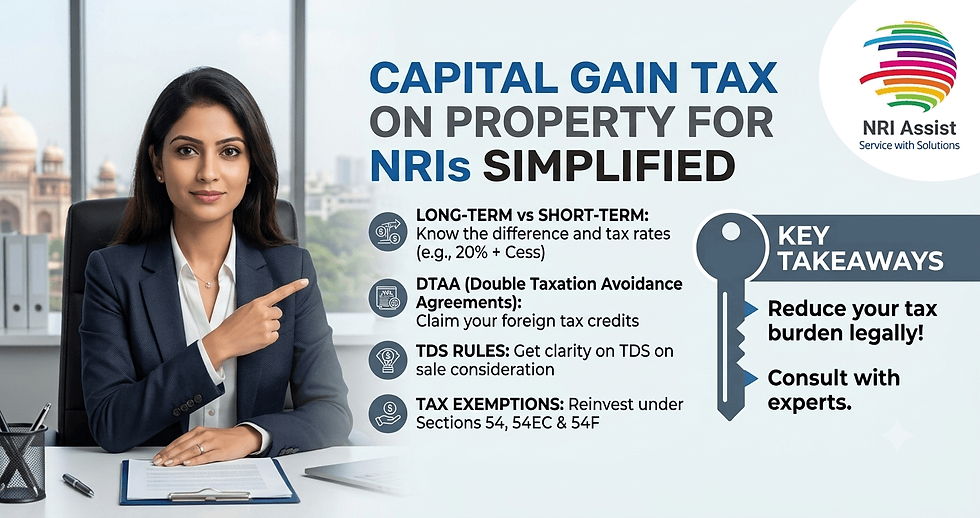
Selling property in India is a notorious compliance marathon for NRIs. While residents benefit from a simple 1% TDS via Form 26QB, NRIs face a steep withholding tax—often 12.5% to 31.2%—calculated on the gross sale value, not the actual profit.
NRIs are hoping for:
TDS Parity: Extending the PAN-based Form 26QB route to NRIs to remove the need for buyers to obtain a TAN (Tax Deduction Account Number).
Capital Gains Realignment: A smoother process for obtaining Lower Deduction Certificates (LDC). Currently, getting an LDC can take months, often causing buyers to back out of deals.
3. Rental Income and the 31.2% Tax Wall
Most NRIs keep a "slice of home" in the form of real estate. However, the taxation on rental income is punishing. Tenants are required to deduct 31.2% TDS on rent paid to NRIs.
The Demand: A reduction in this withholding rate to align with the actual tax slabs of the individual. Lowering the friction on rental yields would incentivize NRIs to invest in India’s booming residential and commercial sectors.
4. Digital Repatriation and Faster Refunds
In 2026, "paperless" should mean paperless. Moving funds from an NRO (Non-Resident Ordinary) account to an NRE (Non-Resident External) account still involves a flurry of 15CA and 15CB forms and manual bank interventions.
NRIs are looking for a unified digital portal for seamless repatriation and real-time tracking of tax refunds, which are notoriously slow for non-residents.
Summary Table: Current vs. Expected
Feature | Current Status (2025-26) | NRI Expectation 2026 |
Residency Threshold | 120 days (if income > ₹15L) | 182 days (Uniform) |
Property TDS | ~14.95% to 31.2% on Gross | 1% on Gross (or actual gains) |
Buyer Compliance | TAN & Form 27Q required | Simple Form 26QB |
Rental TDS | 31.2% | Aligned with Tax Slabs |
Ultimately, the diaspora wants a budget that rewards their long-term faith in India’s growth by cutting through the red tape.
Visit our Home Page Click Here


Comments